Vienna
City guide · Vienna State, Austria · Austria
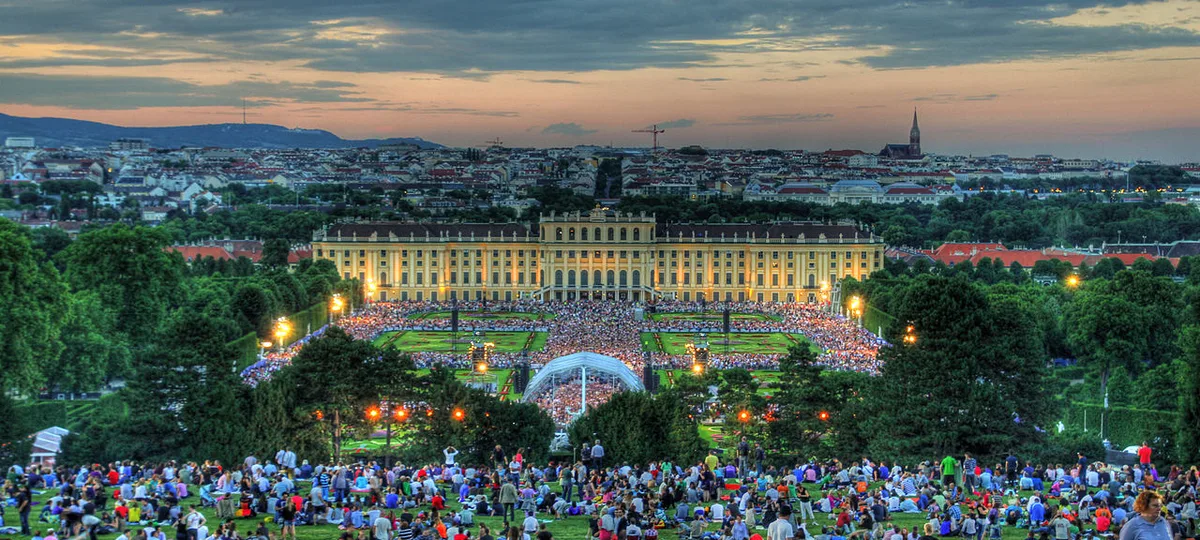
Schönbrunn Palace – former imperial summer residence · St. Stephen's Cathedral – Gothic cathedral in the city center
About Vienna
Vienna is the capital, most populous city, and one of the nine states of Austria, serving as the country's cultural, economic, and political centre. It lies on the eastern edge of the Vienna Woods at the transition to the Pannonian Basin, sits on the Danube, and is traversed by the regulated Wienfluss. The city is completely surrounded by Lower Austria and is located roughly 50 km west of Slovakia and its capital Bratislava, 50 km northwest of Hungary, and 60 km south of Moravia in the Czech Republic. Vienna is known for its imperial heritage, including landmarks such as Schönbrunn Palace, St. Stephen's Cathedral (Stephansdom), the State Opera, the Hofburg, Karlskirche, and the Belvedere. The Historic Centre of Vienna is a UNESCO World Heritage Site, designated in 2001 under cultural criteria ii, iv, and vi, covering an area of 371 hectares. The city's population was recorded at 2,028,499 in 2025, with a metropolitan area of nearly 2.9 million, representing nearly one-third of Austria's population. Vienna is the fifth-largest city by population in the European Union and the most populous city on the river Danube.
Who this destination fits
Highlights worth planning around
Strong fit
- Rich imperial heritage with iconic landmarks including Schönbrunn Palace, Stephansdom, the State Opera, Hofburg, Karlskirche, and Upper Belvedere
- Historic Centre is a UNESCO World Heritage Site (designated 2001, criteria ii, iv, vi)
- Compact and walkable city core with a well-developed public transport network
- Safe and culturally vibrant destination suitable for first-time visitors to Central Europe
- Strong cultural scene as Austria's political, economic, and cultural centre
Tradeoffs
- Historic Centre of Vienna was listed as an endangered UNESCO World Heritage Site from 2017 through 2026
- Can feel crowded during peak tourist seasons in the historic center
- Higher cost of living and travel compared to other Central European capitals
- Weather can be cold and grey in winter, limiting outdoor sightseeing comfort
Plan the trip
Best time to visit
Late spring (May–June) and early autumn (September–October) offer mild weather and fewer crowds, though this is editorial guidance rather than a current seasonal guarantee.
Planning lead time
2–3 days is sufficient for a first visit to cover the historic center and major landmarks, with additional days recommended for deeper museum exploration.
Decision factors
Safety
Vienna is generally considered a safe city for travelers, with low violent crime rates. Standard urban precautions apply, especially in crowded tourist areas where pickpocketing can occur.
Trip Budget Calculator for Vienna
Estimate your travel expenses based on duration, style & group size
Global planning baseline. Flights use a generic estimate.
* Commission may be earned from qualifying partner bookings.